Atelier EPC2026 sur la démographie climatique : Dynamiques de population dans un climat en mutationBologne, Italie, 3 juin 2026
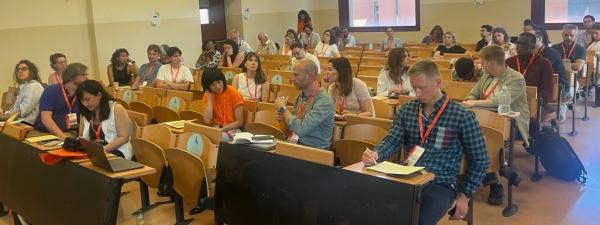
L'atelier intitulé « Démographie climatique : Dynamiques de population dans un climat en mutation », organisé le 3 juin 2026 en amont de la Conférence européenne sur la population (EPC 2026) à Bologne, en Italie, a été organisé conjointement par le nouveau comité de l'UIESP sur la démographie climatique et environnementale et le groupe de travail de l'EAPS sur la démographie climatique.
Cette réunion de lancement a rassemblé une quarantaine de chercheurs pour un après-midi consacré à des présentations et des échanges informels. L'événement a été organisé par Raya Muttarak (Université de Bologne, Université Bocconi), Risto Conte Keivabu (Max Planck Institute for Demographic Research), Jasmin Abdel Ghany (Nuffield College/University of Oxford), Tobias Rüttenauer (Goethe University Frankfurt), Emilio Zagheni (Max Planck Institute for Demographic Research) et Maria Rubio-Cabañez (Centre d'Estudis Demogràfics, Barcelone). Parmi les participants figuraient aussi bien des chercheurs en début de carrière que des démographes, géographes, épidémiologistes et climatologues confirmés, reflétant ainsi la nature pluridisciplinaire de la démographie climatique.
L'atelier s'est déroulé de 13h30 à 17h00 dans le cadre du programme préliminaire de la Conférence européenne sur la population. Après un bref mot de bienvenue et une présentation du comité de l'UIESP et du groupe de travail de l'EAPS, trois conférences invitées ont posé le cadre des échanges : Alexander De Sherbinin a traité de « l'habitabilité, de la justice climatique et de la mobilité climatique » ; Mary Abed Al Ahad a abordé « la pollution de l'air et la santé » ; et Roman Hoffmann a parlé des « populations à l'ère de la crise climatique ». Une pause-café a permis des échanges informels avant une table ronde intitulée « Rencontre avec les éditeurs », réunissant Raya Muttarak, Timothy Adair et Alexander De Sherbinin, qui ont donné des conseils sur la publication dans les revues Population and Development Review, Population Health Metrics et Frontiers in Climate. La session s'est achevée par une discussion ouverte visant à planifier les activités et collaborations futures.
Les points saillants des conférences et de la discussion qui a suivi ont mis en évidence la rapidité avec laquelle ce domaine évolue. Alexander De Sherbinin a souligné l'hétérogénéité spatiale de la mobilité induite par le climat ainsi que la nécessité de relier les données issues des sciences du système Terre aux microdonnées sur les ménages et les migrations. Mary Abed Al Ahad a présenté de nouvelles données sur les impacts démographiques de la pollution atmosphérique et a abordé les mécanismes reliant l'exposition à la morbidité. L'intervention de Roman Hoffmann a mis en perspective les pressions démographiques à long terme ainsi que les interactions entre la structure par âge, les systèmes de santé et la capacité d'adaptation. Les participants ont activement débattu des risques combinés (par exemple, vagues de chaleur, pollution, inondations), de la répartition sociale inégale des expositions et des capacités d'adaptation, ainsi que de la nécessité de méthodes avancées pour analyser l'impact des interactions et des séquences des différents 'événements climatiques.
La rencontre avec les éditeurs de revues a été particulièrement appréciée : ces derniers ont souligné les opportunités de numéros spéciaux interdisciplinaires, l'importance de la transparence concernant les données et les codes informatiques, ainsi que les liens de causalité démontrées par les observations scientifiques. Ils ont également partagé leurs points de vue sur les lettres accompagnant les soumissions de communications. Lors des échanges en petits groupes et durant la séance plénière finale, les participants ont proposé des étapes concrètes pour la suite : un atelier de formation aux méthodes géospatiales et longitudinales destiné aux jeunes chercheurs, un répertoire de données partagé et l'éventuelle publication d'un numéro spécial consacré aux interactions entre climat et démographie. Ces discussions animées et la diversité des points de vue ont témoigné d'un vif enthousiasme pour consolider le réseau « Climat et démographie ». Si vous souhaitez participer aux activités ou suivre les échanges, veuillez contacter climatedemography@gmail.com et restez informés des prochains événements ici.
|