
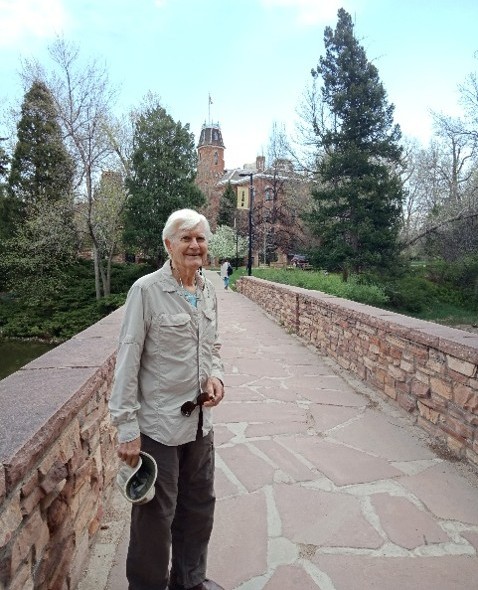
On August 18, Andrei Rogers died peacefully at the age of 88. At the time of his death, he was Professor Emeritus in the Department of Geography at the University of Colorado Boulder. He had joined the IUSSP in 1977.
Andrei Rogers leaves a legacy of research that continues to be highly valued. He received lifetime achievement awards in three disciplines. In 2000, he received the Walter Isard Award from the North American Regional Science Association. In 2006, the International Geographic Union included him in the Legends of Quantitative Geography, a group of scholars deemed responsible for the quantitative revolution in geography. In 2018, the Population Association of America awarded Andrei the Mindel C. Sheps Award for his outstanding contributions to mathematical demography, demographic methodology, and the modeling and analysis of population data.
Before Andrei was born, his parents lived in Vladivostok in the Russian Far East. His maternal grandfather was a Swiss engineer, who had come to Vladivostok as a young professional to work on the Trans-Siberian Railroad. In the 1920s when the Civil War reached the Far East, the family fled to Manchuria, China. Andrei was born in Harbin on the 15th of September, 1937. He spent his early childhood in Shanghai until Mao’s troops encircled the city and allowed foreign residents two months to leave the city. In 1949, his family received a visa to live in the United States and settled in Berkeley, California, where other members of the extended family were living already.
Andrei studied architecture at the University of California, Berkeley. He entered graduate studies at the University of North Carolina, Chapel Hill, and was awarded a PhD degree in City and Regional Planning in 1964 at the age of 27. He then returned to California and was appointed Assistant Professor of City and Regional Planning at the University of California, Berkeley. A year later, he was promoted to Associate Professor with tenure. As part of his research, he produced population projections for metropolitan and non-metropolitan areas of California for the State Development Plan. The regional projection model he developed was published in the journal of Demography in 1966. Several papers followed and in 1968, he published his first book on Matrix Analysis of Interregional Population Growth and Distribution (University of California Press, Berkeley). It was followed by Matrix Methods in Urban and Regional Analysis (Holden Day, San Francisco, 1971). In 1969, Andrei spent a six-month leave in Rio de Janeiro to help develop a national information system for urban planning and local development. During that time, he studied Nathan Keyfitz’s Introduction to the Mathematics of Population (Addison-Wesley, 1968) and developed the idea to add a spatial dimension to the demographic models Keyfitz discussed. The models he envisaged considered a system of geographical units (regions) with region-specific fertility and mortality and migration by regions of origin and destination. Matrix methods provide the ideal mathematical basis for the modeling the demographic dynamics in a system of regions. Multiregional demography was born.
In 1970, Northwestern University in Evanston, Illinois, offered Andrei a full professorship and invited him to create a multidisciplinary educational program in the newly established Urban Systems Engineering Center. At Northwestern, spatial modeling and spatial population analysis became significant parts of the training and research. Andrei attracted several graduate students and within five years, he completed his book on Introduction to Mathematical Multiregional Demography, published by John Wiley (1975). The book covers the life table, the cohort-component projection model and stable population analysis for a system of regions. Models are presented in discrete and continuous time. The book also includes a chapter on estimating demographic measures from incomplete data.
In 1975, Andrei started a sabbatical at the International Institute for Applied Systems Analysis (IIASA) in Laxenburg, Austria. He and his family loved Vienna and the sabbatical became a stay of eight years at IIASA. It was here that Andrei put multiregional models into practice and initiated the Migration and Settlement Study, a comparative study of population dynamics involving all 17 member countries of IIASA. Subnational data on population, fertility and mortality, and migration by origin and destination were assembled in a standardized format and processed using software developed at IIASA. The study triggered advanced methodological research, and resulted in 17 national case studies published as IIASA Research Reports, a large number of articles in academic journals, and the training of national scholars at IIASA. The methodological research and the empirical findings in the case studies culminated in an edited book on Migration and Settlement. A Multiregional Comparative Study (Reidel, 1986). The new generation of population models attracted attention from scholars across the globe who engaged in multiregional demographic studies. It also attracted attention from outside of spatial demography. The National Science Foundation sponsored a conference in 1981, which resulted in the edited volume Multidimensional Mathematical Demography (Academic Press, 1982).
In 1983, Andrei started a new stage of life at the University of Colorado Boulder. He was appointed as a Professor of Geography in the Department of Geography and the Director of the Population Program in the Institute of Behavioral Science. Here, he developed an interdisciplinary program for demography, appointing academics from the departments of Sociology, Economics and Geography. The program also funded Master’s and PhD students to conduct interdisciplinary studies on population issues. His research continued advancing multiregional projections and model migration schedules with applications to active life expectancies, elderly migration and regional foreign-born population change. He published books on Elderly Migration and Population Distribution (Belhaven Press, 1992) and Multiregional Demography: Principles, Methods and Extensions (Wiley, 1995), along with many journal articles. After directing the Population Program for 20 years, Andrei retired from the University of Colorado Boulder, in 2008, aged 71. Retirement did not mean the end of research – he published three more books in 2010, 2015 and 2020. During the span of his academic career, he published 13 scientific books and 98 journal articles.
Between completing his undergraduate studies at the University of California, Berkeley, and entering graduate school at the University of North Carolina, Chapel Hill, Andrei married Maria in 1960. They had four children: Mike, Chris, Kevin and Laura. Maria died from cancer in 1997. Andrei remarried in 2001. He is survived by his wife Mary Ann, his four children, 13 grandchildren and 10 great-grandchildren.
At the age of 80, Andrei published his memoir, entitled But in my case. An immigrant’s life story (iUniverse, 2018). The scholar of migration had himself followed a remarkable migratory path, shaped by historical events and unexpected opportunities. He ends his book with three lessons he learned. First, life is full of challenges. Coping with these challenges demands perseverance. Second, the world changes a great deal during a lifetime. It requires accommodating to change. The third lesson is to live every day like we will die tomorrow, and to learn like we will live forever (Gandhi). He concludes: “Do not postpose your ‘bucket list’ to tomorrow, because tomorrow may never come.”
We extend our sincere condolences to Andrei’s family.
Frans Willekens and James Raymer
The family opened a website where people can share memories.