IUSSP Initiative on Population Registers, Ethics and Human Rights
Table of Contents ● Our Current Focus ● Our Team
● A Brief History
● Our Impact
This website is updated monthly. Recent postings:
 Description The overall purpose of this initiative is to address the ethical and human rights challenges emerging as population register systems are modernized and digitized, in particular the persistent inequalities in access to these systems, and the implications over the life-course. Legal identity systems, and population registers, offer much opportunity to advance inclusive societies, as recognized by Sustainable Development Goal (SDG) Target 16.9 (“universal legal identity for all, by 2030”). Many low- and middle-income countries have been modernizing their population register systems as part of broader efforts to advance inclusive legal identity systems. Such systems can be core parts of digital public infrastructure through which health, social, economic and other services can be delivered, thus also contributing to the achievement of other SDG targets. This is essential because we are witnessing a global data emergency. Currently, 1.2 billion people do not have legal identity – that is one in eight people globally. Our work seeks to address these gaps, with a focus on the economic, social, and cultural rights impacted by issues of registration – from births, to marriages, to deaths, and all the corresponding life events in between. Our Ultimate Goal: Changes in global guidance and in national registry systems to increase birth registration and to support the delivery of basic services to all people. 
This work is made possible due to generous support from the International Development Research Centre (IDRC), Canada.
Our Current Focus The IUSSP Initiative on Population Registers, Ethics and Human Rights engages with these issues, and seeks now to address the impacts of population registers and legal identity systems in two areas, both with immense challenges and opportunities: - sexual and reproductive health and rights, and
- the implications of the climate crisis for action.
We are infusing interdisciplinary perspectives, drawing on expertise from law, history, economics, public policy, demography, and public health, in all aspects of this project, alongside work with early career fellows across multiple academic fields. This project is now in its third phase. The current 2.5-year initiative runs from January 2025 to June 2027 and is led by the International Union for the Scientific Study of Population (IUSSP), Wits Institute for Social and Economic Research (WiSER, South Africa), and the USC Institute on Inequalities in Global Health (IIGH, USA). It builds on the 2022-2025 project: Initiative on Population Registers, Ethics and Human Rights which, amongst many research and interdisciplinary dialogues and activities, hosted a residential fellowship program for three early-career researchers and practitioners. Our current program of activities is organized across Research and Knowledge Creation, Events and Convenings, and Mentorship. Further details on each area are included below. These areas are representative of our strategic activities. Research and Knowledge Creation
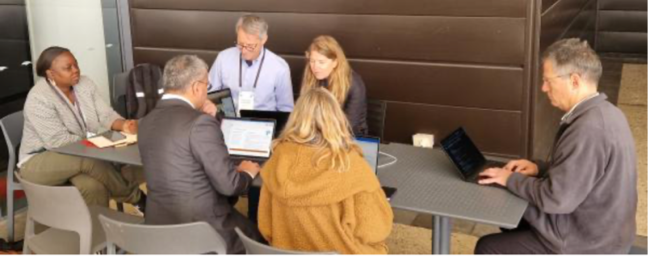
Our aim is to expand knowledge and understanding of issues of rights, ethics and inclusion concerning population register systems amongst international population scientists - with a focus on how digitalization of population registers affect sexual and reproductive health and rights (SRHR) and climate change (CC) action. Key Activities in 2025 and 2026: Convene and disseminate new knowledge about the linkages between the digitization of population registers and legal identity systems, and the advancement of sexual and reproductive health and rights, and climate crisis action. This includes: - Develop a strategic research agenda for the IUSSP Scientific Panel, IIGH and WiSER on inclusive population registers, SRHR and climate change action.
- Consultation with IDRC partners engaged on climate change to explore strategic areas of overlap between population registers and climate change action.
- Research and writing to support production of research products on (i) measurement and benchmarks of inclusivity of population register systems, (ii) population registers and global health issues, and (iii) population registers and climate change resilience.
Publications: Podcasts: Events and Convenings
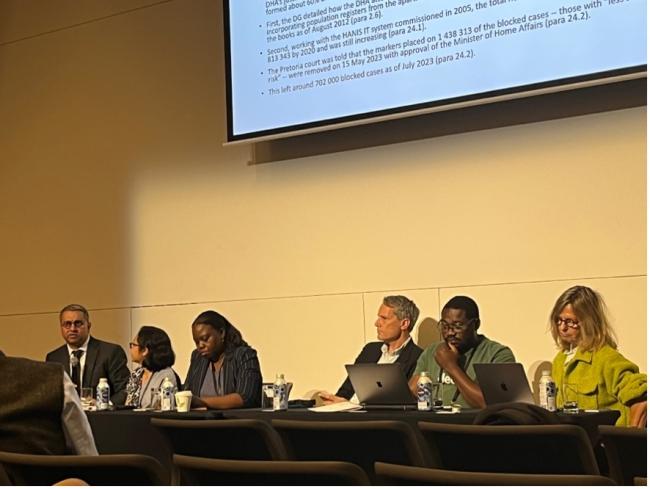
We inform global health policy makers and practitioners on the opportunities and implications of digitized identity systems and population registers systems for health-related human rights - with a special focus on policy and practitioner convenings on SRHR and climate change action. Key Activities in 2026: Leverage the expertise of the collaborating institutions to shine a light on inequalities and challenge existing systems, through the conduct of presentations and convenings. This includes: - Convene a virtual session to showcase research from South Africa, Uganda, Cameroon, and Brazil on population registers by Population Fellows.
- Canadian Conference on Global Health Session on population registers, global health and international development -- to update Canadian global health community about the strategic opportunities, challenges and risks that modernization of population registers entails.
- Participation at Bhalisa Network Meeting on population registers in Washington DC to advance scholarly/practitioner/policy exchange.
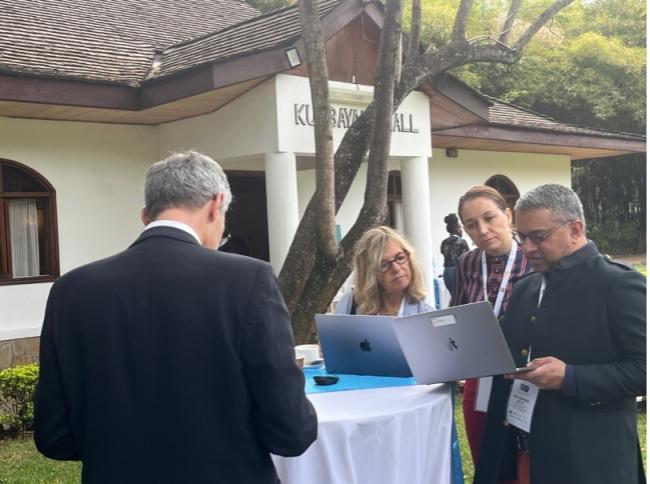
Key events in 2025: Nairobi, Kenya (October 2025) As part of our collective work to improve the technical quality of population registers including to ensure that systems are inclusive, trusted and appropriately used, members of the IUSSP Initiative on Population Registers, Ethics and Human Rights traveled to Nairobi, Kenya to participate in multiple meetings. All of the sessions shed light on content issues and discussed how best to foster attention to the human and human rights dimensions of the design and implementation of population register systems. These meetings included the 4th Global Civil Registration and Vital Statistics (CRVS) and Gender Symposium, which brought together representatives from government, international organizations, civil society, and academic institutions from over 40 countries to explore the intersections between gender and CRVS systems, as well as the Expert Group Meeting: Consolidating Lessons from the Field and Synthesizing International Technical Standards on Population Registers and their Usability, hosted by the National Institute of Statistics, Uruguay (INE), Statistics Norway and the United Nations Population Fund (UNFPA) in collaboration with the International Union for the Scientific Study of Population (IUSSP) and its Scientific Panel on Population Registers, Ethics and Human Rights. 4th Global CRVS and Gender Symposium, Nairobi, Kenya - “Counting Her In: Addressing Disparities in Female Death Registration for Improved Equity, Rights, Public Health”
- “Major Developments in CRVS and Gender”
- “Parallel Sessions on CRVS Systems Assessment, Coordination and Digitalization and Gender Considerations: Digitalization”
- “Panel Discussion - Advancing Gender Transformative CRVS Systems to Accelerate Societal Inclusion Across the Life Course”
Expert Group Meeting: Consolidating Lessons from the Field and Synthesizing International Technical Standards on Population Registers and their Usability, Nairobi, Kenya. - “Accelerating Progress Towards Gender Transformative Systems to Accelerate Societal Inclusion Across the Life Course”
- “Consolidating Lessons from the Field and Synthesizing International Technical Standards on Population Registers and their Usability”
- "Review Progress towards Updating and Maintaining Population Registers in Selected Countries
- “Review of Recent use Cases of Population Registers in Selected Countries”
- “Coverage, Quality and Inclusiveness Assessments and their Implications for Updated International Standards and Technical Cooperation for Population Registers”
- “Technical Standards on Inclusive Population Registers - Where are we? What do we Need? What Next?”
- “World Cafe Tables and Panel Discussion - Accelerating Progress Towards Gender Transformative Systems to Accelerate Societal Inclusion Across the Life Course”
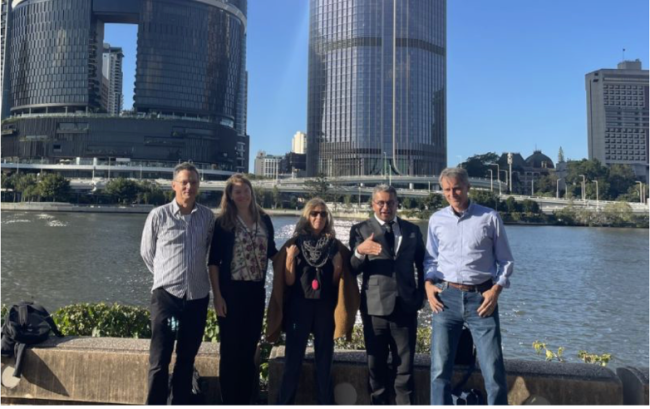
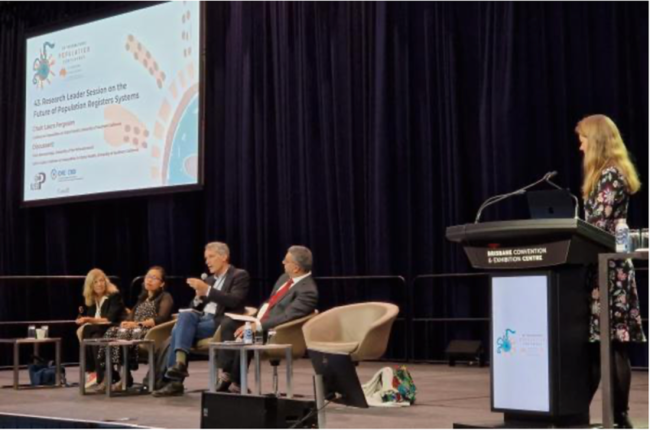
Brisbane, Australia (July 2025) 30th International Population Conference, Brisbane, Australia Through their longstanding partnership, faculty and staff from the International Union for the Scientific Study of Population, UNFPA, the University of the Witwatersrand Wits Institute for Social and Economic Research, the USC Institute on Inequalities in Global Health, as well as the Fellows, as members of the IUSSP Initiative on Population Registers, Ethics and Human Rights traveled to Brisbane, Australia, to participate in plenary and side sessions at the 30th International Population Conference, as well as conducting a wide range of working sessions. The team shared updates on their research on population registers, ethics and human rights. In addition to presenting at conference plenaries, panels and workshops, a series of internal meetings were held to plan for the next two years of the work, which includes increased attention to how sexual and reproductive health and climate change relate to population register systems. - “Research Leader Session on the Future of Population Registers Systems”
- “Population Registers, Human Rights and Ethics”
- “UNFPA Plenary on A Population Data Emergency: The Silent Threat to Global Development”
- “Vital Statistics Production, Dissemination and Usage”
- “Gender-Biased Sex Selection”
Mentorship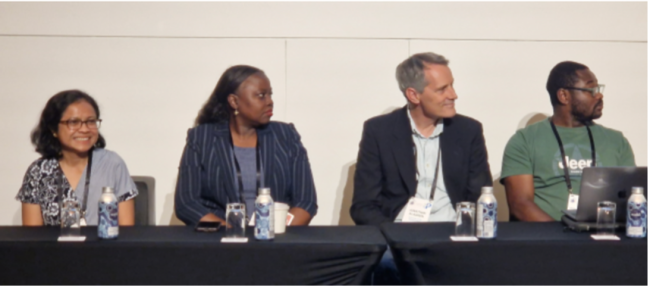
Mentorship is at the heart of our initiative. We have been mentoring 3 early-career fellows (two research fellows and one practitioner fellow) for the past five years. This includes supporting their research and practitioner engagement and co-creating research and practitioner knowledge products together, including publication of their own work. Our dedicated mentorship time with fellows is now winding down, and those who have been mentored are moving into roles as co-creators in this work.
- Mentor 1 early-career research fellow to publish a scholarly article about population registers and societal inclusion in Uganda - with a focus on vulnerable subpopulations.
- Mentor 1 early career research fellow to facilitate knowledge exchange, translation research and interdisciplinary engagement between scholarly, policy, practitioner networks.
- Mentor 1 early career on challenges, risks and opportunities of CRVS/ID data as a base layer for artificial intelligence applications by the public and private sectors.
Key Activities in 2025: Brisbane IPC2025 outputs: Publications: Our Team - Romesh Silva - Technical Specialist, Health & Social Inequalities, UNFPA Technical Division, United States; Chair, IUSSP Scientific Panel on Population Registers, Ethics and Human Rights.
- Keith Breckenridge - Professor and Deputy Director, Wits Institute for Social and Economic Research (WiSER), University of Witwatersrand, South Africa.
- Jonathan Klaaren - Professor of Law and Society, Wits Institute for Social and Economic Research (WiSER) & School of Law, the University of the Witwatersrand, South Africa.
- Laura Ferguson - Associate Professor and Director, Program on Global Health & Human Rights and Institute on Inequalities in Global Health, University of Southern California, United States.
- Sofia Gruskin - Professor and Director, Institute on Inequalities in Global Health, University of Southern California, United States; Member, IUSSP Scientific Panel on Population Perspectives and Demographic Methods to Strengthen CRVS Systems.
- Elizabeth Atori - Legal Officer, Initiative for Social and Economic Rights (ISER), Uganda (2020-2024)
- Claudio Machado – Senior Digital Consultant, The World Bank
- Georges Macaire Eyenga - Ph.D in Sociology from the University of Paris Nanterre (France), is interested in African technoscapes and how increasing technicisation is shaping space, sovereignty and governance regimes in Africa.
- Elizabeth Nansubuga - PhD in Population Studies, North West University (South Africa), Lecturer in Population Studies, Makerere University, is interested in ethical issues around legal identity and civil registration systems.
- Janaina Costa - Lawyer, MSc in Economic and Social Development from IEDES - Paris 1 Panthéon-Sorbonne, postgraduate degree in Digital Law from the State University of Rio de Janeiro (Brazil), is interested in citizen empowerment and uses of emerging technologies for the public interest.
IUSSP Secretariat - Paul Monet - Deputy Director, International Union for the Scientific Study of Population (IUSSP).
A Brief History The current 2.5 year initiative builds on earlier work by the IUSSP Scientific Panel on Population Registers, Ethics and Human Rights, carried out from 2022-2024, and before that, a grant from 2019-2022. That initiative, which was conducted from January 2022 to September 2024, entailed (i) the hosting of 3 early-career fellows at the Wits Institute for Social and Economic Research (WiSER) in Johannesburg, South Africa and Initiative for Social and Economic Rights (ISER) in Kampala, Uganda with mentoring support from the Institute on Inequalities in Global Health at the University of Southern California (IIGH) and IUSSP, (ii) conducting interdisciplinary mentored research by senior researchers and early-career fellows, (iii) participation in multiple international meetings and conferences (including ID4Africa, Certizens Workshop), (iv) research dissemination webinars (co-hosted with the International Development Research Centre (IDRC) and IUSSP), and (v) publication of new research and think pieces. This work continues in the current iteration of the initiative.
Our Impact Below are some key activities from the first two phases of this work that connect to our goals. Articles
- 2023
- 2024 - Georges Macaire Eyenga: Au Cameroun, la difficile mobilisation des électeurs, in Afrique XXI.
- Jonathan Klaaren: Changing Digital Identity Systems Across Africa: A Sociotechnical and Political Economy Mapping of Initiatives for Digital Public Infrastructure. In WISH Seminar, WiSER, Wits University, 2023.
- Georges Macaire Eyenga: Technicisation des registres de vote et participation matérielle au Cameroun, in Réseaux.
- Georges Macaire Eyenga: Digitalisation versus droits humains et éthique, in AOC.
- Cachalia, Firoz and Klaaren, Jonathan: ‘Towards a Public Law Perspective on the Constitutional Law of Privacy in South Africa in the Age of Digitalization’ 2023 Journal of African Law.
- Georges Macaire Eyenga: La fabrique de l’électorat. Pour une praxiographie de la participation politique au Cameroun, in Participations 2024/3 N° 40, pages 195 à 222
Events
- 2019
- 2020 - 2021 - 2023 Fellowship Activities - 2023 Press, Announcements, and Interviews - 2022 - 2023 - 2024 |
