
Mobility and Migration Trajectories and Health Inequalities Across the Life CourseBrussels, Belgium, 29 June 2026
The IUSSP Scientific Panel on Lifetime Migration organized the Symposium on Mobility and Migration Trajectories and Health Inequalities Across the Life Course at the annual conference of the Society for Longitudinal and Life Course Studies (SLLS), held 29 June-1 July 2026 at the Université Libre de Bruxelles (Belgium). The symposium was coordinated by Claudia Brunori, Justė Lekštytė, and Sergi Vidal (Autonomous University of Barcelona), with Sergi Vidal chairing the session. Around 35 participants attended the symposium, which stimulated an engaging discussion on migration trajectories and health inequalities across the life course.
The symposium brought together five studies using longitudinal survey and population register data from several European countries to examine the health implications of residential mobility and migration from a life-course perspective. The contributions explored the long-term consequences of family migration strategies for the health of the 1.5 generation (Claudia Brunori), variations in mental health trajectories following union dissolution by migration background in the Netherlands (Christiaan Monden, University of Oxford), the timing and cumulative effects of neighbourhood disadvantage in childhood on adult health behaviours (Justė Lekštytė), the lasting mental health consequences of early-life internal and international migration (José David López-Blanco, UNED and University of Bologna), and the relationship between adult children's migration and loneliness among older parents across Europe (Margherita Odasso, Centre for Demographic Studies, Barcelona). Together, the papers showcased the value of trajectory-based and longitudinal approaches for advancing our understanding of the complex links between lifetime mobility and health.
The symposium highlighted the importance of viewing migration and residential mobility as dynamic life-course processes embedded within family, neighbourhood, and institutional contexts, while demonstrating the potential of longitudinal data and innovative analytical approaches to generate policy-relevant evidence on health inequalities. 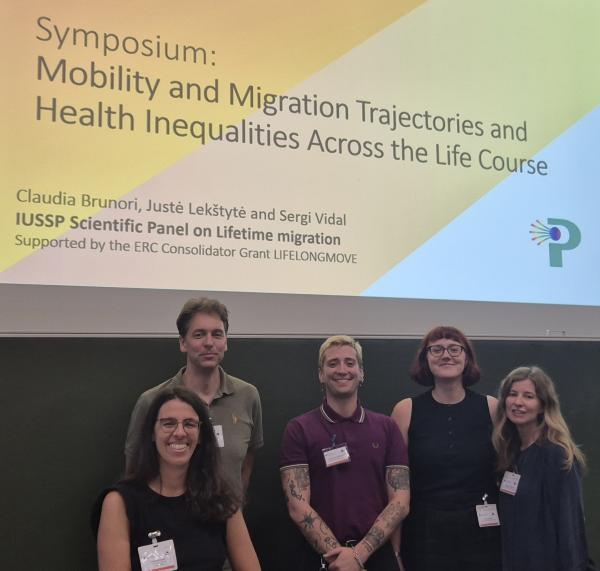 |