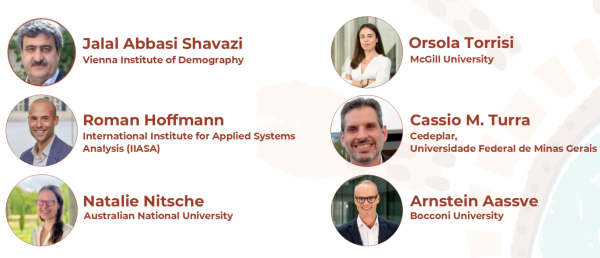
On 3 March, the IUSSP revived its webinar series with Toward a Demography of Crisis and Resilience, revisiting a plenary session from the International Population Conference (IPC2025) in Brisbane last July. Bringing together leading scholars working on climate change, armed conflict, pandemics, and economic shocks, the discussion explored how demography can better understand populations in an increasingly unstable world.
Moderator Jalal Abbasi-Shavazi (Vienna Institute of Demography and IIASA) opened by noting that while crises are not new, today’s context is marked by their simultaneity, interconnection, and persistence. Climate change, conflict, pandemics, and economic instability are no longer isolated events but form the structural backdrop to demographic processes. This raises a key question: are existing concepts and data systems adequate for a world where instability is recurrent rather than exceptional?
Roman Hoffmann (IIASA) highlighted climate change as both an environmental and social crisis, shaped by inequality and vulnerability. With an estimated 1.8 billion people exposed to heightened climate risks, he emphasized the need to integrate demographic insights into climate research, particularly regarding migration, health, fertility, and mortality.
Focusing on armed conflict, Orsola Torrisi (McGill University) examined its longer-term and indirect demographic effects. Beyond mortality and displacement, conflict influences family dynamics, health, and inequality through complex social and psychological pathways. She also underscored the challenges of working with incomplete or contested data in crisis settings.
Natalie Nitsche (Australian National University) reflected on lessons from the COVID-19 pandemic, particularly its uneven impacts across populations. She called for more integrated approaches that link health crises to broader demographic processes, including family behavior, migration, and inequality.
Cassio Turra (Cedeplar, Brazil) explored how economic and political shocks shape demographic outcomes, emphasizing the role of institutions. Policies and social protection systems can determine whether crises lead to temporary disruptions or lasting demographic change.
Arnstein Aassve (Bocconi University) concluded by reframing resilience as the capacity to adapt and transform, rather than simply recover. While education, health, and institutions can strengthen resilience, responses to crises may also reinforce existing inequalities.
The webinar included an audience Q & A moderated by Nico van Nimwegen. The webinar closed with a call for interdisciplinary collaboration, improved data systems, and new frameworks to understand what is increasingly described as an era of “polycrisis.” Demography, participants emphasized, must evolve to remain responsive to these complex and interconnected challenges.
A full, lightly edited transcript of the webinar is available here for those who would like to read the proceedings. The video recording is accessible below along with the PowerPoint presentations.